

get in touch


For the past two years, the conversation around AI in software development has focused on one question: Which model should we use?
Today, many development teams use multiple AI tools depending on the task. Some developers work with JetBrains AI inside their IDE, while others prefer terminal-based assistants such as Claude Code, Codex or Gemini CLI. Each tool has its strengths, and giving developers the freedom to choose often leads to better individual productivity.
But as AI adoption grows, a different challenge begins to emerge.
How do teams share context? How do organisations understand which AI tools are being used? How do they manage costs, governance and security without limiting developer choice?
JetBrains’ latest announcement isn’t introducing another AI assistant. Instead, it focuses on helping engineering organisations coordinate AI adoption across teams and workflows.
AI is becoming part of the engineering platform
The first wave of AI tooling focused on individual developers.
Ask a question. Generate some code. Explain an error.
The next stage is different.
As AI becomes part of everyday software development, organisations need more than individual assistants. They need ways to connect developers, repositories, workflows and AI agents without forcing everyone into the same tool or model.
That is the direction JetBrains is taking with its new AI offering for teams and organisations.
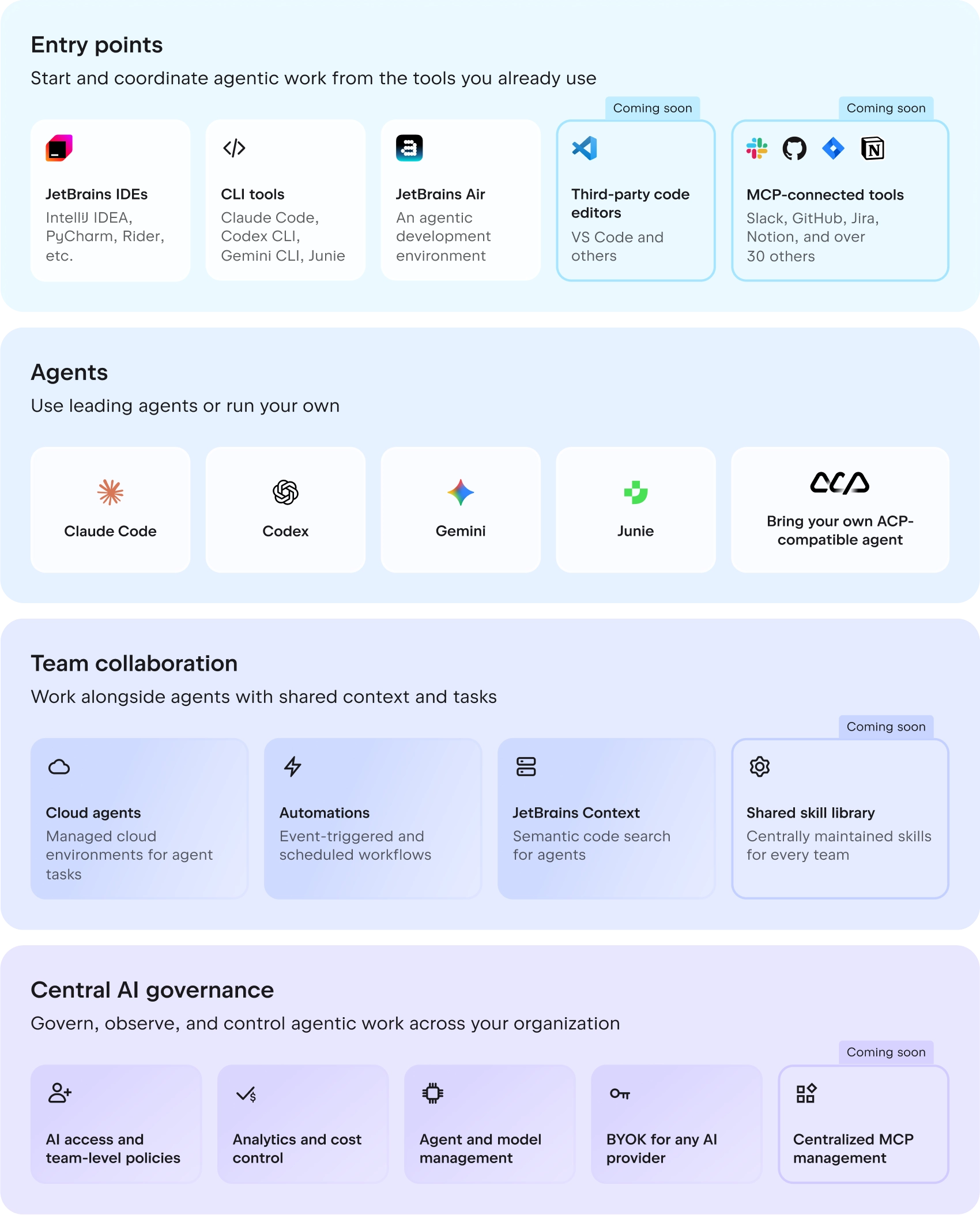
Rather than building another isolated AI experience, JetBrains is creating an open ecosystem designed to work across different tools while giving organisations the visibility and governance they increasingly need.
Image 1. JetBrains is building an AI ecosystem that combines shared context, AI agents, team collaboration and organisation-wide governance. (Source: JetBrains Blog)
Shared context instead of isolated AI assistants
One of the biggest limitations of today’s AI tools is that they often work in isolation.
Each new task starts with limited understanding of the project, forcing developers to repeatedly provide context or allowing agents to spend valuable time exploring unfamiliar codebases.
JetBrains aims to reduce that overhead through several new capabilities.
JetBrains Context is designed to give AI agents faster access to repository knowledge, code examples and project references, allowing them to understand larger codebases more efficiently.
Alongside this, cloud agents and team automations allow long-running engineering tasks to execute in managed environments and respond automatically to repository events or scheduled workflows.
The common thread is clear.
Instead of treating AI as a collection of individual conversations, JetBrains is moving towards shared organisational knowledge that multiple developers and AI agents can build on together.
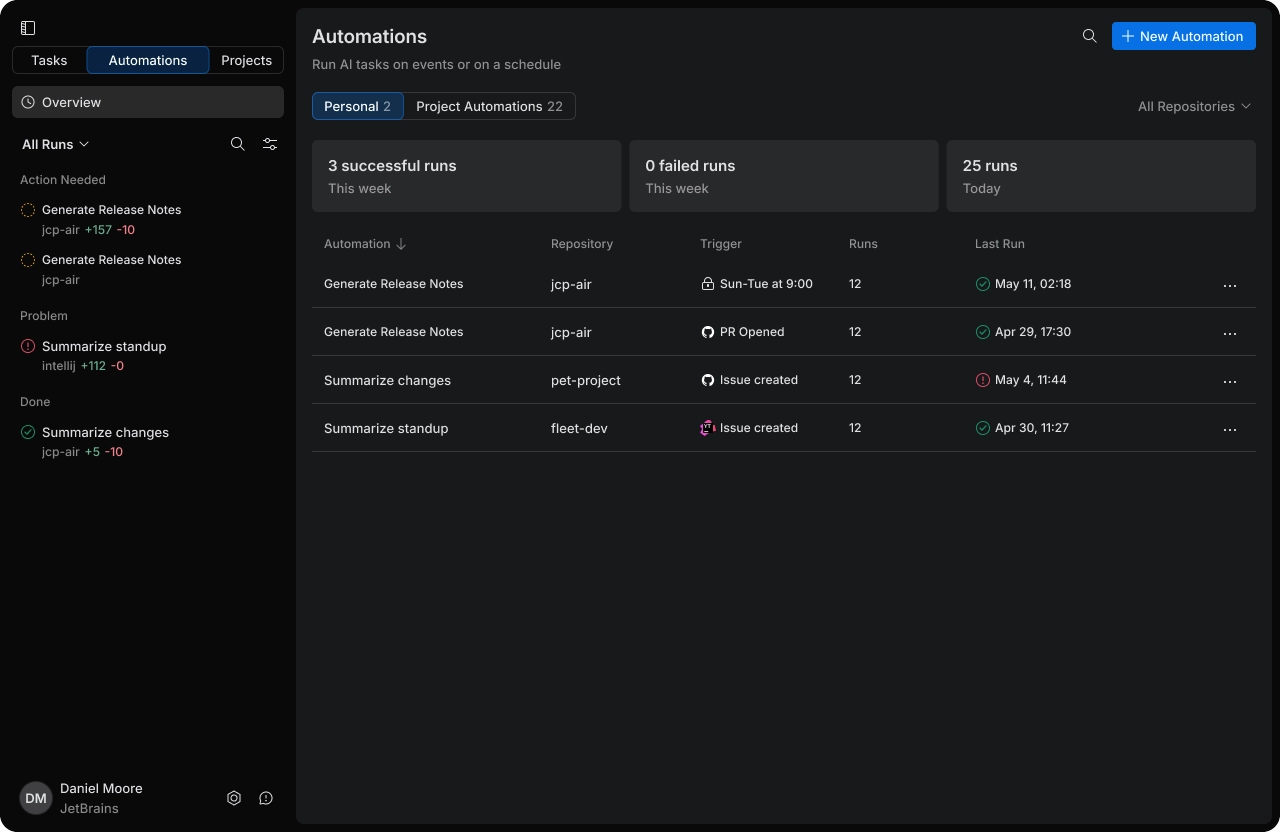
Image 2. Team automations allow AI agents to respond automatically to repository events and scheduled engineering workflows, reducing repetitive manual work. (Source: JetBrains Blog)
Developer freedom without losing organisational control
One of the most interesting aspects of the announcement is that JetBrains is not trying to replace the AI tools developers already use.
Many engineering teams have naturally adopted different solutions.
Some developers prefer Claude Code.
Others work with Codex, Gemini CLI or JetBrains AI inside their IDE.
Rather than forcing standardisation, JetBrains is accepting this reality.
The new JetBrains Central platform is intended to give organisations a single place to understand and manage AI adoption across the business.
That includes visibility into AI usage, governance policies, access management, model controls, analytics and cost attribution.
Developers continue using the tools they find most effective, while engineering leaders gain the oversight needed to manage AI responsibly.
This balance between flexibility and governance may prove more valuable than introducing yet another AI model.
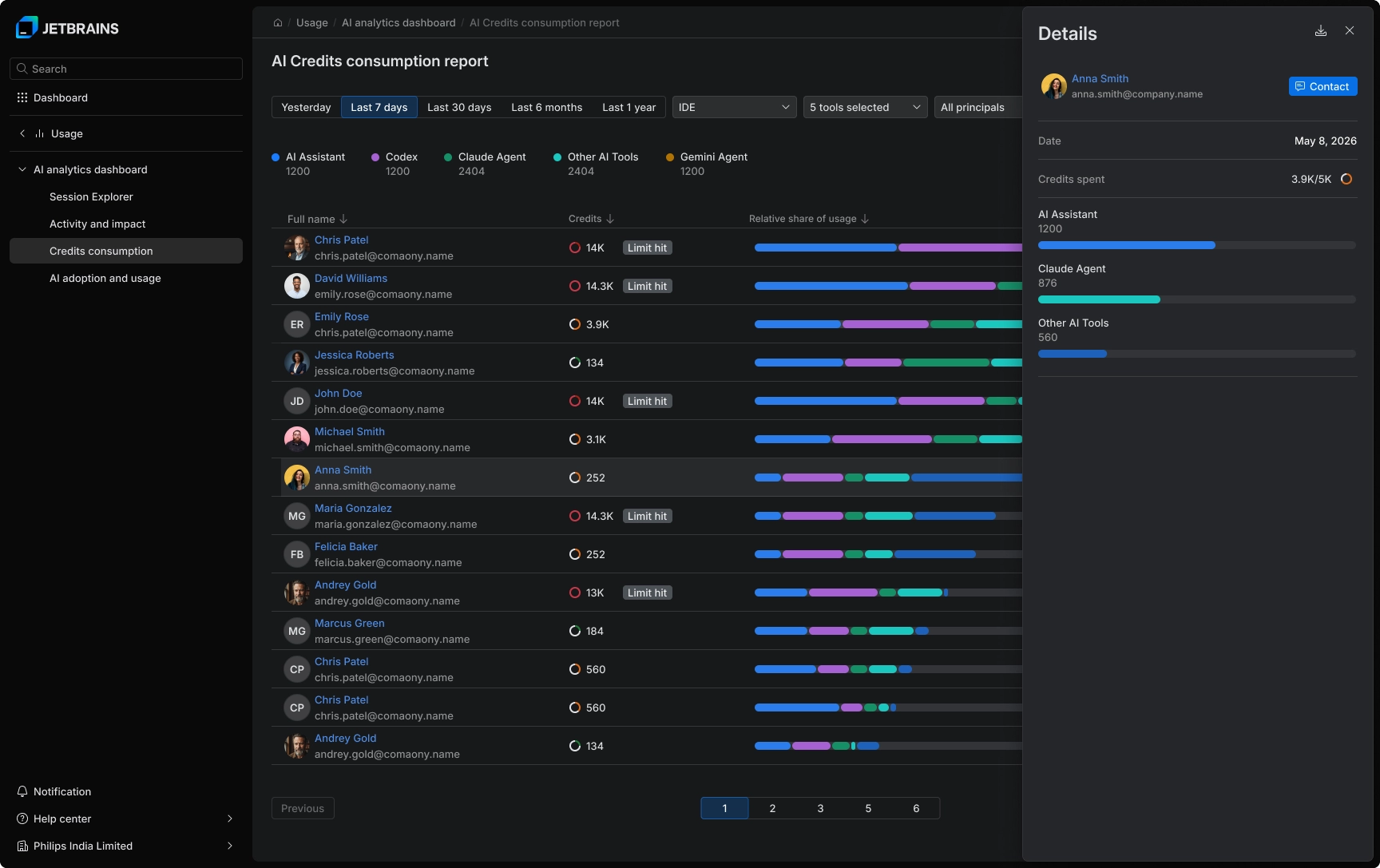
Image 3. JetBrains Central provides visibility into AI usage, governance and cost management while allowing developers to continue using their preferred AI tools. (Source: JetBrains Blog)
AI credits tell a bigger story
Alongside the technical announcements, JetBrains is also changing how AI is licensed for business customers.
Instead of monthly AI licences, organisations will gradually move towards a flexible credit-based model.
While this may sound like a commercial update, it reflects something larger.
AI is becoming another engineering resource to manage.
Just as organisations monitor cloud spend, infrastructure usage and software licences, AI usage is becoming something that requires planning, visibility and optimisation over time.
The introduction of AI credits supports that shift by giving organisations greater flexibility to allocate resources where they create the most value.
Looking beyond individual productivity
The first generation of AI tools helped individual developers work faster.
The next generation is tackling a different challenge.
How do hundreds of developers collaborate with AI while maintaining consistency, security and visibility across an organisation?
JetBrains’ latest announcement suggests the answer isn’t choosing a single model or assistant.
It’s building an environment where developers, AI agents, repositories and organisational knowledge work together.
As AI becomes part of everyday software development, platforms may increasingly be judged not only by the intelligence of their assistants, but by how effectively they help entire engineering teams coordinate their work.
otherTech Blog
01
 02
02
 03
03
 04
04
 05
05

In the news
Java 27 is here – but staying current shouldn’t disrupt your development workflow
30.09.2026
Tech Blog
IntelliJ IDEA goes LSP – what happens when IDE intelligence stops being tied to the IDE?
31.08.2026
In the news
The real shift in AI coding agents is workflow, not model choice
30.06.2026
In the news
Small changes, less friction – recent JetBrains updates worth knowing about
26.05.2026
In the news
CLion 2026.2 is focused on the work around the code